
Getting a new AI vendor approved inside a large organization is often slower than building the integration itself. Procurement, security review, a new contract to negotiate, all before a single API call gets made. TimeGPT is now available through Microsoft Foundry, external link, which changes that path for Azure customers: deploy it inside your own Azure subscription, get billed as standard Azure consumption, and skip the separate vendor review since Microsoft has already vetted it as part of listing the model. For practitioners, nothing about the API changes. You're using the same TimeGPT you already know; it's just faster to get approved and deployed.
What you get
TimeGPT is Nixtla's foundation model for time series forecasting. Point it at historical data, sales, demand, traffic, sensor readings, and it returns forecasts zero-shot: no training run, no hyperparameter tuning, no forecasting infrastructure to stand up and maintain.
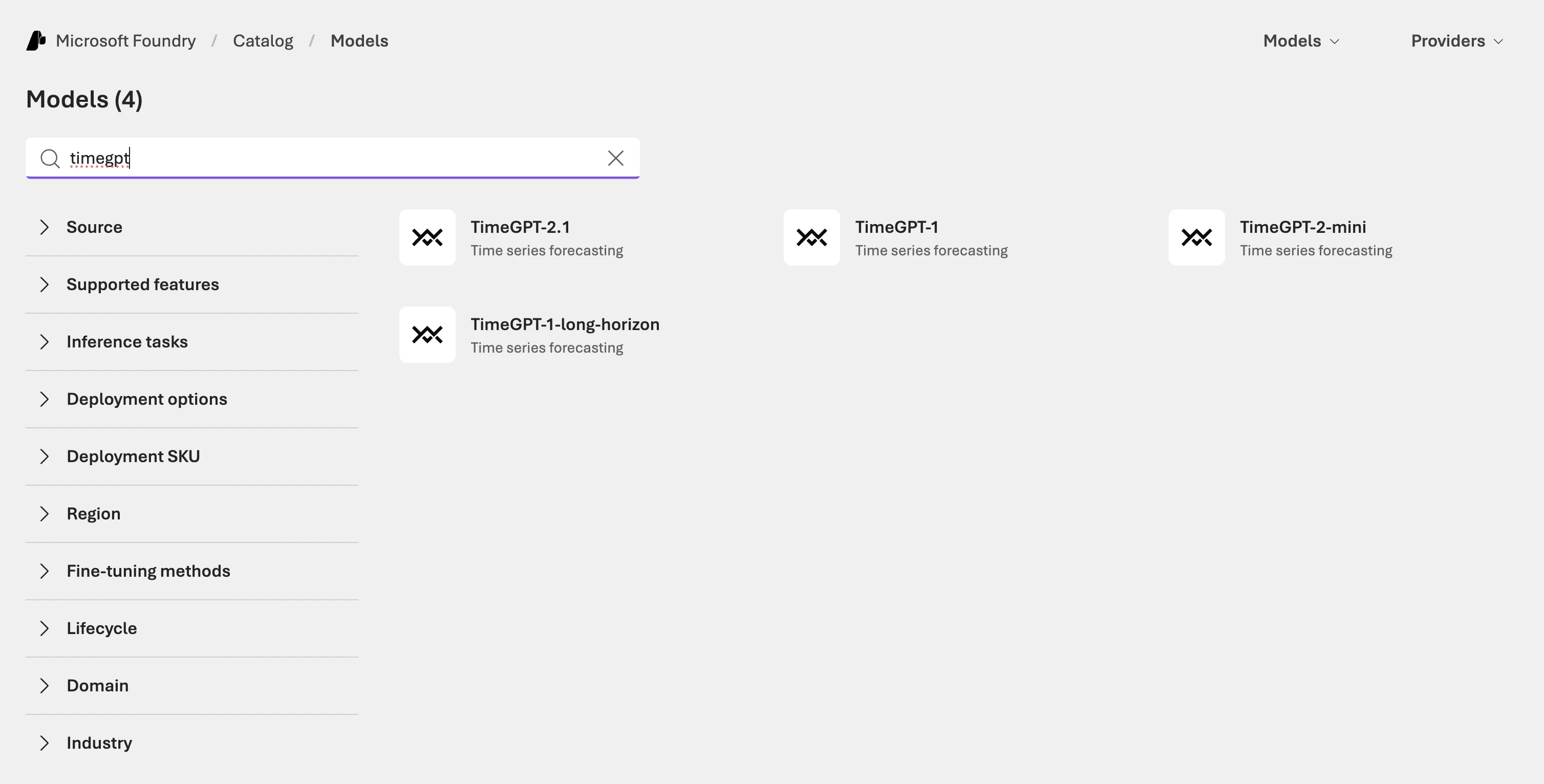
In the Microsoft Foundry model catalog, TimeGPT appears as four separate model listings, each a different model, so you deploy the one that fits your workload:
- TimeGPT-1 — the original production-ready foundation model, pretrained on 100B+ time series data points; general-purpose zero-shot forecasting and anomaly detection for short- to medium-range horizons.
- TimeGPT-1-long-horizon — same lineage, trained specifically for forecasts spanning 2+ seasonal cycles (e.g., hourly demand three months out, monthly sales two years out) — reach for it once your horizon outgrows the standard model.
- TimeGPT-2-mini — the lightweight member of the newer, more accurate TimeGPT-2 family, tuned for fast, low-cost inference in resource-constrained or high-throughput settings.
- TimeGPT-2.1 — the current flagship of the TimeGPT-2 family: a single model built for any deployment scale, including self-hosted and on-premise, with stronger exogenous-variable handling, multivariate forecasting, lower minimum data requirements, and faster fine-tuning.
Deploy with Managed Compute
TimeGPT deploys today through a hub-based project using Managed Compute — make sure Azure Marketplace purchases are enabled on your subscription first, since Nixtla's models are offered as a partner listing sold through Marketplace.
-
Open the Microsoft Foundry model catalog, external link and search "timegpt".
-
Open the model card and select Sign in to get started — make sure the "New Foundry" toggle is turned off first, since hub-based projects and Managed Compute deployments only show up in the classic view.
-
Set an instance count and VM size, then select Deploy.
-
Once the deployment is healthy, copy its endpoint URL and key — you'll need both to authenticate.
Make your first forecast
Install the SDK and call the API with the endpoint URL and key from your deployment:
import pandas as pd
from nixtla import NixtlaClient

nixtla_client = NixtlaClient(
    base_url="YOUR_DEPLOYMENT_TARGET_URI",
    api_key="YOUR_DEPLOYMENT_KEY",
)

df = pd.read_csv("https://raw.githubusercontent.com/Nixtla/transfer-learning-time-series/main/datasets/air_passengers.csv")

forecast = nixtla_client.forecast(df=df, h=12, time_col="timestamp", target_col="value")
fig = nixtla_client.plot(df, forecast, time_col="timestamp", target_col="value")
fig.savefig("forecast.png")
That's it — a 12-step forecast, no model training required.
Try it today
TimeGPT on Microsoft Foundry means enterprise teams can move from "let's evaluate this" to a working forecast in the same afternoon, without a procurement cycle standing in the way. For practitioners, it's the fastest path yet from idea to a forecast running in production. Check out the model catalog, external link or dive into the TimeGPT quickstart docs to get started.